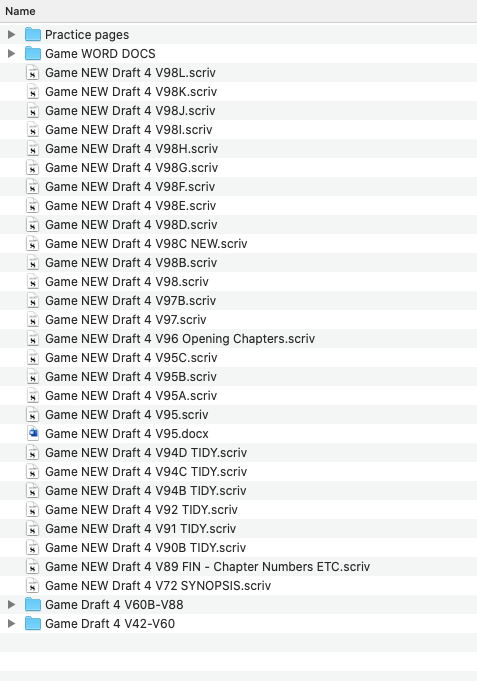
THE FOURTH DRAFT was another kind of slog but definitely more enjoyable. I felt much more in control, most of the writing was now in place and I knew where things had to be tightened up and where certain details were missing or unnecessary. New sections were written. People had generally responded well to my dialogue which I had always thought was my weak point yet weren’t overly impressed with my descriptions or more poetic asides, which I thought were my strongest.
I stupidly hadn’t realised how much writing a single novel would involve: thousands of words written and discarded, shelved, trimmed down, reduced or lost for ever. It was mind-boggling. Like making a small jug of sauce from a cupboard full of ingredients! A single change made on page 12 or 49 could have repercussions throughout the entire manuscript. The novel had become so huge in my psyche that I had to cut and paste an individual chapter into a seperate document (which I called ‘practise pages’) so I could work on it without feeling too stifled.
On the Arvon course, both of the tutors were great. Among the many good tips they gave, Claire Fuller spoke about detailing locations so I strenuously went through the entire book and did just that while Jarred McGinnis said that not all of your writing had to go into the book and you may write a chapter whose true purpose is simply to get you to ready to go on and write the chapter that needs to go into the book. This helped me enormously. A writer friend, Tom Kelly, said he’d get his characters to write letters to one another, thousands of words, before he wrote a single word of his novel. All of this started to make a lot more sense. I lapped up podcasts with writers reading and speaking (my favourite being The New Yorker: Fiction – thank you, thank you).
I submitted a new draft to CD Rose and the rewrites he suggested were much less painful: Chris was a great teacher and very supportive. It’s important for a budding writer to get robust feedback from professionals. I then submitted the manuscript to Manda Waller, a copy editor, thinking she’d simply go through and prune sections, tighten up the language here and there. Again I was mistaken. This whole process proved to be informative and exciting too: a learning experience in its own right. Manda produced an editorial review that flagged up things for me to consider – luckily not too many. She provided pointers around coherent use of past perfect (or pluperfect) tense slipping into past tense and then back again for flashbacks (which my novel did). She flagged up my use of tentative language, dialogue tagging, action beats, timeline nudges, vocatives and contractions. She’s even laid it out properly: it was beginning to feel like a proper book.
When I put the finishing touches on the manuscript I was shocked that draft 4 contained 98 sub-drafts and some of these were subs of sub-drafts! But what an unforgettable feeling of relief. The only analogy I could think of was pregnancy: it physically felt like the novel was now outside of me for the first time. Drafts three and four of the book had taken an intensive two and half years and I was wiped out.



Leave a Reply